Balls and Walnuts
more than you ever wanted to know
Monthly Archives: April 2010
Yet another variation of the student’s dream
Here we are at the beach: one of those quiet, nearly deserted coves south of Gold Beach which can be bitter cold when the wind is up, or Edenic on a sunny morning. It’s morning, the sun is up, and there are many of us. From the parking area we hiked down a steep, dry gully to get to a shore tracked by dogs and gulls. Damp sand made virginal by the receding tide, snaking line of cream-white shell fragments, smooth stones sparkling and popping a million tiny voices as the ocean sucks another wave back down. A rumble, a crash from the wrong direction, and the gully is no more. We’re trapped in the cove.
And I have surgical cases at 8 AM at my little hospital in Gold Beach.
We go our various ways. I climb one of the nearby bluffs that ring the cove and find a trail leading back to a concrete parking structure that has no business on the Southern Oregon coast. There it is, my in-laws’ old brown Camry. As soon as I get in and start the engine, the Camry turns into a go-kart, only it’s still a Toyota, so of course the accelerator sticks and I have a devil of a time not crashing on this suddenly crowded San Francisco avenue. And now it’s LA County Hospital where I have those 8 AM cases, and not only do I not have the time to make my start, I can’t seem to remember the OR’s phone number. Can’t even tell them I’m going to be late.
It goes on and on like that. There’s a part where I’m inching along at two or three or four miles an hour, part of a parade sandwiched between a clown car and a bronze centipede that roils along like a dragon on Chinese New Year; there’s another part where I tell myself if I can only find the freeway, I’ll be fine, but when I stop and ask directions from a guy on the street, he yammers gibberish at me, and all his friends laugh. It goes on and on.
And I’m thinking now that I should have stayed in that cove. Maybe that’s how you defeat a student’s dream.
D.
What’s not to like?
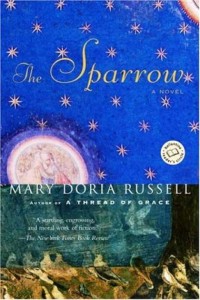 About a week ago, I finished Mary Doria Russell’s 1996 novel The Sparrow, which won all kinds of awards and, as far as I’m concerned, deserved them all.
The Sparrow is a first contact novel in which the Society of Jesus engages with intelligent life in the Alpha Centauri system, on the planet Rakhat. From the prologue, which concludes with the ominous, “They meant no harm,” you might think you know the end of this story; and indeed, it’s clear from the first pages that the Stella Maris’s crew met with disaster. Only one crew member survives — Emilio Sandoz, Puerto Rican Jesuit, bastard and baseball player, would-be saint and all-around nice guy — and he stands accused of murder and prostitution. The man is a PR nightmare.
The story is told with two intertwining narrative threads, one beginning with the discovery of extraterrestrial song by a SETI scientist working at Arecibo, Puerto Rico in 2019, the other beginning in 2059 with the Church’s hurried attempts to sequester Sandoz from the public eye. That Sandoz in 2059 is a changed man relative to Sandoz in 2019 (albeit just a few years older, thanks to relativistic effects) is evident from the outset. The younger priest wrestles with an imperfect faith but is otherwise joyful, while the older Sandoz gives damaged a whole new dimension. The mystery and much of the narrative drive stems from the questions: what happened to Sandoz (and the rest of the crew), and will he ever be whole again?
For much of the book, Russell’s pacing and characterization are masterful. I was grateful that she let me know upfront that all would end in tragedy because she does a stupendous job developing her eight crew men and women. Even knowing the outcome, I cared deeply for all of them, most of all Sandoz, and their fate was heartbreaking.
Yes, The Sparrow is a tearjerker, but it’s so much more: it’s a study of cultures not so much in conflict as in confusion; an exploration of sexuality and religion, of the bonds of family and friends, of the relationship of people with their God. All that, and yet it never felt “talky” or “preachy” (not at all like a Heinlein novel, in other words). Best of all, Russell respects the reader enough to explore these ideas without putting forward her own biases, at least not in any obvious way, and with her ending she offers no easy answers.
Not a perfect novel by any stretch, though. Mostly I was bothered by the rushed feeling in the last fifty pages. Major traumatic events happen off camera, told secondhand, as if Russell didn’t have the heart to write the scenes, or perhaps she didn’t think her readers would have the heart to read them. After a few hundred pages of masterful stonewalling, Sandoz gives his Jesuit inquisitors what they’ve wanted all along — his version of events — and the shift feels precipitous. And this is a book with an all too brief denouement, leaving the reader with a major WTF moment at the end. (Good planning on Russell’s part, though, since I instantly bought the sequel, Children of God. The usual story . . . dying to know what happens next.)
As for the sequel, I suppose I should reserve judgment until the end, but 3/4 of the way through I feel like Russell should have taken Elmore Leonard’s dictum to heart (cut the stuff that others skip). I’m glad I bought it because it does give a sense of closure to The Sparrow, and I understand why Children of God is flawed. Russell, I think, really wanted to tell the whole story of what happened on Rakhat following the debacle of the first Jesuit mission, so the sequel is in many ways more of a history than a novel. The focus had to shift from one riveting character to a number of folks who shaped a planet’s history. There’s a loss of dramatic punch in such a gear-change, and face it, histories aren’t as much fun as novels.
The Sparrow may not be the best book for the hard SF fan. The aliens are not terribly alien and the planet never feels like much more than a country the size of Denmark (no, not even when the Stella Maris is surveying it from above). Russell never falls into the It was raining on Mars trap, but I could tell world-building was not her strength when she wrote this. Culture-building, yes, and character-creation, absolutely. But world-building? Nope.
Enough complaints, though. This was one of those rare books that I had to read in every spare moment — a book that became more important to me than videogaming. What higher compliment can I pay it? And it had more genuine feeling to it, more pathos and poignancy, joy and sorrow, than any book I’ve read in a long time.
If you do read it, let me know what you think 😉
D.
Easter Sunday
. . . and a very happy Easter Sunday, too, to all my non-Jewish, non-heathen friends. I’d say non-Muslim, too, except my only Muslim friend follows me on Facebook but doesn’t read my blog.
On this Easter Sunday, I’d like to offer a toast to all the less successful messiahs, including Simon Bar Kokhba, whose transiently successful revolt led to he formation of a second century Jewish state, which required 12 Roman legions plus auxiliaries to put down;
Spanish Kabbalist Moses Botarel, sorcerer, philosopher, and master of the Jewish art of self-promotion; he
stated that the prophet Elijah had appeared to him and appointed him as Messiah. In this role he addressed a circular letter to all the rabbis, asserting that he was able to solve all perplexities, and asking them to send all doubtful questions to him. In this letter (printed by Dukes in Orient, Lit. 1850, p. 825) Botarel refers to himself as a well-known and prominent rabbi, a saint, and the most pious of the pious.
Simon Magus, a first century proto-Gnostic Christian heretic who might have been able to levitate — at least, that’s what his enemies said about him — and who was played by Jack Palance in The Silver Chalice;
90-year-old Unification Church founder Sun Myung Moon, whose followers invite impressionable undergrads to dinner parties only to meet new and interesting people and learn from them — no, really!
And my personal favorite, Moses of Crete, who in the 5th century convinced other Cretan Jews to attempt a trans-Mediterranean journey to the Promised Land by foot; many of his followers drowned, some were rescued, and Moses himself was never seen nor heard from again.
D.
Cosmo jumps the shark
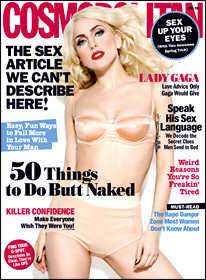 It’s true. I haven’t done a Cosmo 13 in a very long time, because eventually the mag’s self-satire undermined my own feeble attempts at humor. After the third or hundredth headline promised, Twenty-four New Ways To Make Her Beg For More! and delivered,
1. Give her a sensuous massage at 1 AM.
2. Give her a sensuous massage at 2 AM.
3. Give her a sensuous massage . . .
. . . I decided to call it quits. For several years, I had wondered who made up Cosmo’s target audience. I came to the conclusion it was composed of young women who find titillation in French words like frottage yet blanch at anatomically accurate descriptions (thus, Grip his member firmly, and don’t forget to fondle his two little friends). Women who, for thrills, like to put sprinkles and chocolate chips on their vanilla ice cream.
Naturally, this month’s cover grabbed my attention. (Cosmo covers often do. Who wouldn’t want to learn Ten Ways to Make him Pass Out from Ecstacy?) I mean, really: what topic could be so racy Cosmo couldn’t talk about it on the cover?
Take a moment to think about it. Come up with your best guess and then join me below the fold.
Received from NetFlix . . .
Allegro non Troppo, one of my favorite films from the 70s. Here’s one small bit.
D.
Time to make your peace
Approximately 48 hours ago, the CERN Large Hadron Collider broke a record for high-energy particle collisions, with proton beams colliding with a remarkable combined energy of 7 tera-electron volts. Yes, I know, “collison,” “colliding,” sloppy writing, hopeless repetition. But I’m having a hard time finding the motivation to craft clean, crisp journalistic prose.
Excuse me. I’ve got to compose myself.
A lot of us joked about the LHC bringing on the end of the world — mechanism usually being the creation of an Earth-consuming black hole. Cute in-joke because those of us in-the-know were well aware that a microscopic black hole would evaporate before it ever got out of the collider’s vacuum chamber. Funny us. Too bad our apocalyptic scenarios were limited by a distinct failure of imagination.

First some background. The fine structure constant, α, numerical value roughly 1/137, is (per Wikipedia) “a fundamental physical constant, namely the coupling constant characterizing the strength of the electromagnetic interaction.” One way of measuring α is with the Quantum Hall effect, which specifies among other things that electrical resistance in a supercooled wire is precisely quantized. Supercolliders rely heavily on supercooling, of course, so alterations of the Quantum Hall effect — if such a thing were possible — would show up as anomalous readings by the LHC’s internal circuitry.
For the rest of the story, I’ll quote from today’s interview of CERN spokesman Jurgen Schukraft by PBS reporter Dwayne Myers:
JS: Something was playing havoc with our oscilloscopes. A simple AC sinusoid looked slanted as if blown by a stiff wind. At first we thought of magnetic leakage. Anyone who has held a strong magnet near a cathode ray tube — a television, for example — knows what it can do to an electron beam. This was quickly ruled out, yet we had no explanation for our oscilloscopes.
DM: I understand [California Institute of Technology Professor of Physics] Curtis Schramm was the first to check Hall effect readings from your liquid helium cables.
JS: Yes, with the finding that they were off. Way off, close to 6%, but systematically deviant. And since the quantized resistance values were consistently aberrant, it was a simple matter to discern that [fine structure constant] alpha was off by the same degree.
DM: So the fine structure constant, one of the fundamental constants of the universe, had somehow shifted within the central cavity of the collider.
JS: And subsequent measurements at our remote sites first in Sadigny, then in Le Cannelet, indicate the change is propagating outward.
DM: Like a wave?
JS: Sadly, no. The change moves outward radially from CERN, but it’s picking up speed and magnitude. This morning, [Professor of Nuclear Physics] Bartolomeo Galvez at Universidad Carlos III of Madrid recorded the alteration of alpha as the “wave,” as you call it, propagated through his laboratory. The change had increased to just over 6%.
DM: So physicists around the world will soon have to alter many of their textbooks.
JS: This would be true, if it were worth the effort.
DM: Excuse me?
JS: At the present rate, when the “wave” reaches our sun in 2012, alpha will measure 0.121. At that value, stellar fusion will be quite impossible.
DM: So our sun will —
JS: Snuff it, yes.
From Science News.
Me? I’m going to spend my remaining months eating deep-fried Snickers bars and Twinkies.
D.