Balls and Walnuts
more than you ever wanted to know
About Walnut

View all posts by Walnut
Woo-hoo! I totally rock with the ladies!
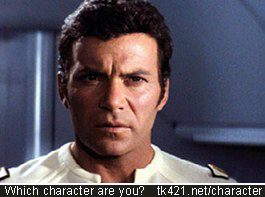
Think about it. You always knew I was Kirk. Consider the similarities:
Kirk: wears a hairpiece.
Doug: needs a hairpiece.
Kirk: prefers to be the center of attention.
Doug: ditto.
Kirk: hammy enough to appear with Ricardo Montalban and still be the hammiest actor present.
Doug: in first grade, I owned the role of Chicken Little.
(Shaking fist: “Skyyyyyyy!”)
Kirk: made women, humans and green-skinned aliens alike, melt out of their spandex costumes.
Doug: just give me a chance!
Yeah, I could go on.
D.
Thursday Thirteen, a day late
 |
Thirteen Things about Doug 1. For as long as I can remember, I have had difficulty distinguishing Thursday from Friday.2. I also had trouble telling my left from my right. My usual response was, “What difference does it make?” Fortunately, I learned the difference before becoming a surgeon.
3. I named my first frog Cyrus Molybdenum. 4. By the end of third grade, I had memorized the symbols for all of the chemical elements (103, at the time). Despite this Badge of Extreme Geekdom, I still had lots of friends. 5. My grandfather, a Polish immigrant, claimed he’d been born with horns. He often showed me the scars. He also claimed he kept a monkey in the attic, but would never let me see him. 6. Pre-1970, my favorite film was Mysterious Island. I can imitate giant bee noises to this very day. 7. At age two, I developed my first crush on an older woman. She was six, and I kept losing to her when we played King of the Hill. She wouldn’t let me stand at the top of the hill, ever. Bitch. 8. The first dirty joke I ever learned was the Gomer Pyle joke. 9. In the early years of elementary school, with the Apollo missions all the rage, I wanted to be an astronomer when I grew up. Astronaut was the conventional response. Later, after I’d read a bit of science fiction, I decided I wanted to be a cryobiologist. Nobody knew what that word meant, and that was cool. 10. I used to fantasize about the Men in Black long before it became fashionable. Sinister men in dark suits and sunglasses would appear one day in our school’s auditorium and whisper things to our principal. He would say, “Doug Hoffman? Can you come to the front of the room?” and I would comply. “These men say you’re extremely important to our nation’s security,” he’d say quietly to me. “They want you to leave with them.” And I’d say, “Heck, yeah!” This was well before the era of extreme rendition. 11. I also had sexual fantasies long before I knew a thing about sex. In one, I stood on a pier and noticed that the Girl of My Dreams was drowning. I jumped off the pier, rescued her, and carried her dripping body back to shore. She would revive in my arms and say, “Oh, you are so special.” The End. The fact that I didn’t know how to swim never entered into it. I was special, after all. 12. I haven’t wet the bed since age two, I never set fires, and I never tortured any animals, large or small (unless you count tormenting red ants). I am thus better qualified to be President than George W. Bush. 13. And yet I have never, ever fantasized about becoming President of the United States. |
The purpose of the meme is to get to know everyone who participates a little bit better every Thursday. Visiting fellow Thirteeners is encouraged! If you participate, leave the link to your Thirteen in others comments. It’s easy, and fun! Be sure to update your Thirteen with links that are left for you, as well! I will link to everyone who participates and leaves a link to their 13 things. Trackbacks, pings, comment links accepted!
View More Thursday Thirteen Participants
D.
Editing: How I do it
Believe it or not, one of y’all emailed me questions about writing. Me. The guy who has only published stories in e-zines and one, ONE, print mag, Continuum.
I felt flattered, and more than a little like a charlatan, but then I remembered how many books I have picked up and put down because of inferior writing. Why should I have to be a published author to pontificate, when so many published authors so clearly suck at their craft? And I mean suck.
Not naming any names, mind you.
Then I realized: in surgery, we do this all the time. Folks with no academic experience whatsoever publish “How I Do It” articles, because the rest of us enjoy reading about a different perspective. You don’t have to be Josef McBlough, III, PhD, MD from Haaaahvaaaahd to write one of these articles, and in fact, none of us private practice guys would listen to Joe McBlough because we all know he has residents to Do It. He couldn’t take a tonsil out to save his soul.
Before I launch into the How I Do It portion of our program, don’t forget to check out PBW’s Ten Things for Editing Novels, which includes links to Holly Lisle’s articles, and PBW’s article, too (her method is close to mine, with a few neurotic quirks on my part . . . more below). I haven’t read all of those articles, by the way, and I’m not sure I will. (Frankly, Elizabeth Lyon’s Can Your Novel Pass this Test? made me want to scream by question #2.) But, at least now you have a quickie link to other resources.
By the way, don’t forget to buy Renni Browne and Dave King’s Self-Editing for Fiction Writers. This is one of my most-thumbed resource books.
But back to my favorite subject (as Maureen likes to point out), me. How am I editing a 306,000 word manuscript?
I never meant it to be that big. Really. I blocked it out on three-by-five cards, wrote out a modestly detailed outline (by chapters, not by scene), began writing, and promptly strayed from the outline. Halfway through the novel, I felt like Wile E. Coyote did when he raced out past the cliff’s edge, paused, and realized gravity had something to say about all of this.
With my ending riveted in my brain — without that, I would have gotten lost — I plunged on, trusting my muse, and she didn’t fail me.
I’ll never be able to write a “fast and dirty” rough draft. Misspellings, grammatical errors, tortured sentences, and even repeated words caused me physical pain. Once I noticed them, they HAD to be fixed.
I reread every chapter after it was written, but by the time I’d finished the chapter, most of the basic errors were gone. Most of ’em never found their way onto the page in the first place.
As I wrote the first draft, problems surfaced which I knew had to be corrected. For the most part, I kept a To Do list for these items. In some cases, however, the problems were so irritating I had to go back and fix them NOW, DAMN IT! because the muse insisted.
Lots of folks will tell you this is bad, that you must work through until you are done and then go back to the earlier material. I’m telling you different: it’s far worse to piss off the muse.
This may have nothing to do with editing, but it has everything to do with my method. I had a real, live audience for this novel, folks who stayed with me to the very end. Knowing that I had to keep them interested forced me to focus on narrative drive and a steady increase in tension.
My audience kept me writing through the dark times. If I failed, I’d be disappointing more than just me. Jona, for one, would fly across the pond and do unspeakable things to me.
Working from my notes, I fixed what I thought were all of the major problems. Done, right? Hah!
I got twelve different-colored highlighters . . .
Just kidding. I worked from a hard copy and corrected as I read, circling problems, writing notes here, there, and everywhere. I kept a new log of Major Problems (65 of ’em, at last count*) which I did not try to fix right away. I tried to identify consistency issues, which scenes I would slash, which scenes were missing, what didn’t work, and what could work better.
That’s where I am right now. Simultaneously, I work from the edited hard copy, and I read/edit on the computer. I call this a read-through because yes, I really do read everything (I’m not just skipping down to the next circled word or underlined sentence).
I correct the 65 Major Problems as I go, but I also keep my eyes open for new problems I may have missed the first time through. Yes, I realize I could edit this to death, but I promise you: this is the last read-through.
Ach, I’m tired. I’d tell you what comes next, but I haven’t made it there yet. Wish me luck.
D.
*These vary from the trivial to the complex. For example:
39. Naka hunt: keep all the numbers straight!
44. Think about where to break into separate novels.
45. Change Mora’s name at the end (the janitor).
That #44, man. It’s a bitch.
Breakfast sausage
. . . the kind that come in links.
Pat brings us a spectacular link from the Space Telescope Science Institute/ESA. So many beautiful images here, I don’t know where to begin. Make sure you check out the Cat’s Eye Nebula. Here’s the Orion Nebula (per the site, okay for public use provided we give attribution to STSci/ESA):

In case you missed yesterday’s discussion in the comments, Mel Gibson is threatening to sue Mel Gibson. Head on over there and offer your support — and advice, too, if you happen to be a lawyer. Jesus’ General has lent a helping hand by reprinting a letter from an Angel of the Lord (Avenging, First Class) to the real Mel. Seems Jesus is none too happy with The Passion, and when Jesus is unhappy . . .
firedoglake gives us the latest in Bill O’Reilly photoshopping goodness. Think Chippendale’s.
Have you missed the fuss over Kate O’Beirne’s book, Women Who Make the World Worse? Ms. (I just know she would love that Ms.) O’Beirne’s diatribe against feminism is taking it in the pink lace panties over at Amazon thanks to the efforts of Jesus’ General, Crooks and Liars, firedoglake, and others. Even the New York Times Book Review (Ana Marie Cox in the January 15 NYTBR) slammed her book, although politely:
Feminism isn’t always pretty (see: underarm hair). Without it, however, Kate O’Beirne would have been unlikely to have this book published — and most women would not have their own money to waste on it.
Guess I should try and get some work done today. Don’t forget to watch Jon Stewart’s and Ed Helms’s taint routine over at Crooks and Liars, and if you missed my post yesterday on Fractales, scroll down a few centimeters and keep reading.
D.
Fractales: the ending (and rules)
Flora held the Critter Keeper up to her eyes, shook the cage, and clucked softly. “Li’l feller’s kinda cute.â€
“Not a chance,†said Bob. He peeled back the foil from his Big Mac and polished off the burger in five bites.
In the Critter Keeper, only a pink smudge remained.
“You can try again,†said Flora.
He patted his hands against his belly. “Yeah, better luck next time. So, Skinny — how would you like to make love to a fat man?â€
Her mouth twitched into a smile. “You mean it?â€
“I’ve been itching to see you in that Cat Woman outfit for the last three weeks.â€
“You got a deal, Doughboy,†Flora said, and plastered him with sloppy kisses.
In case anyone’s curious, these are the last 119 words of my short story “Sprouts,” which hasn’t sold, and is currently not out for consideration. I reserve the right to publish my own version of the story, which I completed in February 2005.
1. Read the whole story chain before deciding how you wish to continue the story backwards.
2. Write however many words you please describing what happens before this snippet. I recommend 150 words or less.
3. Post your contribution on your blog. At the end of your contribution, write “Read what happens next!” (or something similar) and hyperlink it to this blog entry.
4. Cut and paste these rules to the end of your blog entry. It’s that easy!
For those of you who are coming on board at the very beginning, rule #1 is irrelevant. If you’ve read this far, you’ve read the whole story.
You’ll notice I’m not tagging anyone, nor am I giving you a “tag so-many people” rule. If this is a crappy idea, I’d like it to die a natural death, without me flogging it along. Besides, if other folks think this idea is fun, it should take off on its own power — like the blonde joke.
Ready, set, go!
D.
Fractales: here’s the idea.

Remember that dumb blonde joke? It led me to realize the power of the internet*. As blog memes go, the blonde joke possessed humor, originality, and minimal sting to its host — all you had to do was post a bloody link, for heaven’s sake, and rave about the joke. Easy**. Consequently, like any catchy meme, it spread like wildfire.
But what did that meme produce? A single joke. I thought: you know, with a little extra effort, we might have had our own version of the Aristocrats gag, but it wouldn’t have been one joke — it would have been hundreds of them. Thousands.
What we ought to do is tell a story. Tell a million of ’em. It will be just like a story chain, only we need to start at the end, not the beginning. If you think about that fractal tree image, you’ll see the logic in this, since folks will want to follow the story forwards, not backwards. If we (the writers) work backwards, your audience will get to read the story forwards.
Of course, some of them will want to add to the story, and they will do so by continuing the backwards writing process.
I’m going to call this a fractale. Catchy, eh?*** This meme may die a cold, lonely death, but what do we have to lose? Go on, do it! Leave your mark on the tree.
Above, I will post the end of the story and the rules of the game. The rest is up to you.
D.
*No, really. Why must you always assume I’m joking?
**Not like some memes that ask you to name one hundred things you want to do before you die, your one hundred most favoritest songs, and so forth. “Item 99: I would like to finish this meme before I die.”
***A cursory google tells me that ‘fractale’ is French for ‘fractal.’ I don’t see anyone else using the term in this fashion.
Smell the taint
I haven’t blogged about sex in ages. Kate has shamed me into it. Blame her.
Jon Stewart had me in tears tonight. He played straight man to Ed Helms’s extended double entendre on the ‘taint in Washington.’ If I can find a link to the video tomorrow, I’ll post it here.
Here it is, at Crooks and Liars. Enjoy the taint — it’s there to give you pleasure, after all.
Hmm? What’s the taint? Oh, you know what the taint is — it’s the gooch, the durf, the chode, the grundel. Must I explain everything?
By the way: if the odd hand gesture at the end of that skit looked unfamiliar to you, don’t check the Urban Dictionary for shocker, especially if you’re the kind of person who is easily offended by graphic descriptions of off-the-beaten-track sexual practices. I’m warning you, don’t do it.
And if you do, I can’t be held accountable.
In other breaking news, CNN.com reports that an African grey parrot cued his owner in to the fact that his girlfriend had cheated on him with a guy named Gary:
The African grey parrot kept squawking “I love you, Gary” as his owner, Chris Taylor, sat with girlfriend Suzy Collins on the sofa of their shared flat in Leeds, northern England.
But when Taylor saw Collins’s embarrassed reaction, he realized she had been having an affair — meeting her lover in the flat whilst Ziggy looked on, the UK’s Press Association reported.
Ziggy even mimicked Collins’s voice each time she answered her telephone, calling out “Hiya Gary,” according to newspaper reports.
Having sex with some other guy in her #1 boyfriend’s flat? That is low. No wonder Chris Taylor has made certain that everyone else in Leeds (and the world) will know, and tremble at, the name SUZY COLLINS.
Can you tell I ain’t got bupkes tonight?
Feeling cruddy, whine, whine. All I want is to take a shower and go lie down.
See you tomorrow, fiends.
D.
Sheila gets medieval on my . . .
Blog. What did you think I was going to say?
Thanks to PBW’s liberal use of pliers and a blow torch, I hunkered down and did a good bit of editing today. I’m one chapter away from finishing the edit on book one, but that sounds like I’m closer than I really am.
I still have the task of turning this into a stand-alone novel. That means either adding scenes or tweaking scenes to give book one at least a partial sense of closure. And that means finding resonance at every opportunity, and loading it into my final chapters.
In Stein on Writing, Sol Stein devotes a whole chapter to resonance. He doesn’t provide much of a definition:
Resonance is a term borrowed from the world of music, where it means a prolonged response attributable to vibration. In writing it has come to mean an aura of significance beyond the components of a story.
Stein gives examples of different ways of giving your work resonance:
. . . by names, by reference to religious sources, by naming the parts of a book, by the use of aphorisms and epigraphs, and ideally by the writing itself, by the writer’s skillful use of similes and metaphors.
Perhaps I’m using the term incorrectly, but for me, resonance is an echo. Something in the novel makes me resonate — perhaps by the techniques Stein lists, but more often through the author’s use of repetition. Thoughts, dreams, lines of dialogue, and imagery introduced in the novel’s earliest scenes reappear near the end, horribly, tragically altered*. For example, John le Carre used it to great effect in Absolute Friends.
In the chapter I edited today (book one’s penultimate chapter), I used a myth to achieve resonance (I hope). The night is a dome of blinding white light, but we see only darkness, for the sky is full of the shadows of those who came before us. Starlight peeks through between their crowded forms.
Only on a moonless, windless night, can you hear their wings rustling**. My character has heard this all his life from his mother and father, but he never believed it. When tragedy befalls him, everything changes:
Flying eastwards, he fought to keep his eyes open. Every time he closed them, the rustling noise built to a furious crescendo.
Mother, Father? I hear them now. I hear their wings.
You were wrong about the night sky. Any darkness will do.
Chokes me up every time. Remains to be seen what it will do to the rest of you.
Resonance by repetition may be a magic trick, but it’s charged with power. Closure by return. If I do a respectable job of it, my readers will feel that sense of completeness even when faced with one whopping great cliffhanger.
D.
*That assumes you are writing tragedy. Comedy need not work so hard, but those of you who read Terry Pratchett might agree with me that his strongest novels are the ones which harbor, if not a grain of tragedy, then at least a bushel of poignancy: Night Watch, Feet of Clay . . .
**These characters are intelligent black birds. Guess I should have mentioned that earlier, eh?
Martin Luther King, Jr., 1929-1968
The Seattle Times has a huge feature, including student essays, civil rights quizzes, and a time line.
Better, though — shorter, punchier, and more moving — is ReddHedd’s tribute at firedoglake. Read it.
It’s impossible for me to disconnect my liberal-self from my writer-self, and so, as I read firedoglake’s quotes from Dr. King, I can’t help but admire the strength and beauty of MLK’s writing. Parallelism is a powerful tool. I can only think of one other writer who lives on in this ethereal plane: Winston Churchill, who used parallelism, command of the language, and wit to make his point.
D.
Note to self:
. . . put this guy on your blogroll. And not just because he posts about spider-sex. It’s because I still have a thang for Lois.
D.