Balls and Walnuts
more than you ever wanted to know
Category Archives: Books ‘n’ Authors
Stop complainin’
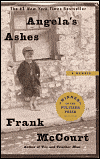 I’ve wanted to read Frank McCourt’s memoir, Angela’s Ashes, ever since I saw him on The Colbert Report. He was promoting his new book, Teacher Man, the third volume of his memoir. The man impressed me with his wit and kindness; if I remember correctly, Stephen Colbert didn’t even try to give him a hard time, but instead kicked back and enjoyed the moment. Unfortunately, YouTube doesn’t have the interview.
I have to admit to some shallowness, though. The title, Angela’s Ashes, sounded like chick lit. And then, when I found out it was a memoir of his early childhood, I figured the title referred to the death of his mother or grandmother (it doesn’t), and that put me off. While in Orlando, I decided to stop procrastinating and buy the book, and . . . wow.
I’m the sort who likes to revel in his awful childhood, so I’m impressed when someone out-awfuls me. Not only does McCourt out-awful me, I may never complain again. (Or at least I’ll stop complaining until I feel like complaining, and then I’ll undoubtedly hear McCourt’s voice in the back of my mind telling me to grow a spine already.)
During the Great Depression, Frank McCourt and his brother Malachy are born in New York City to two Irish immigrants. The death of Angela McCourt’s daughter pushes her into a deep depression, and her relatives decide the thing for her is to move children and husband back to Ireland. Trouble is, Ireland is in even worse straits than America. What follows is an eye-opening tale of survival in the face of crushing poverty, a story that would have been depressing were it not for McCourt’s clear, strong voice.
McCourt has been compared to Joyce, but I found his journalistic spareness and lack of sentimentality more reminiscent of Hemingway (minus the machisimo). Angela’s Ashes seems uncompromisingly honest. McCourt reports the facts, even — especially — when they reflect poorly on him.
I was struck by this comment from the publisher:
Wearing shoes repaired with tires, begging a pig’s head for Christmas dinner, and searching the pubs for his father, Frank endures poverty, near-starvation and the casual cruelty of relatives and neighbors — yet lives to tell his tale with eloquence, exuberance and remarkable forgiveness.
Forgiveness? Really? For me, the most fascinating part of McCourt’s story is his relationship with his mother. Perhaps there will be a rapprochement in McCourt’s second book, ‘Tis, but Angela’s Ashes ended on an unsettled if not hostile note. And for the father who abandons his wife and children, McCourt shows no inclination to forgive.
I think I’ll have my son read this as part of his schoolwork (the joys of homeschooling — we set the curriculum). Then, whenever he kvetches, I’ll tell him, “Stop complainin’. You coulda grown up with nothin’ to eat but bread and tea.”
***
I’m outa here. See you next Saturday for live blogging 😉
D.
PS: There’s a movie (I haven’t seen it), a documentary, and a memoir by Frank McCourt’s brother, Malachy.
SBD: Jackie Kessler, author of Hell’s Belles
As promised, I have something — someone — special here for Smart Bitches Day: Jackie Kessler, author of Hell’s Belles. Look at her. Oy, so cute.
Coming soon: Jackie Kessler, author of Hell’s Belles
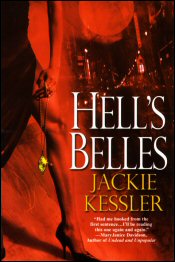 I recall lamenting that Glen Duncan’s I, Lucifer was a good read, but lacked page-turnability and, well, sex. Duncan strived so hard for the Literary, Fun got sacrificed along the way.
Not so Jackie Kessler’s Hell’s Belles, which was a blast from start to finish. Read the first chapter here. Michelle gave it a shout-out some time ago, so I checked it out. Jezebel, a succubus on the lam from Hell (with assorted demons, an incubus, and a Fury hot on her tail) has a delightfully distinctive voice: humorous, passionate, so full of joie de mal. True to form for a succubus, I loved her instantly.
Here’s the good news: Ms. Kessler has agreed to an interview. Woot! I already know my first question:
You write so convincingly about the predations of the succubi. In lascivious, dripping detail, please tell us all about the research you did in order to write with such authority.
I’ll keep y’all posted.
D.
SBD: Ellora’s Cavepeople
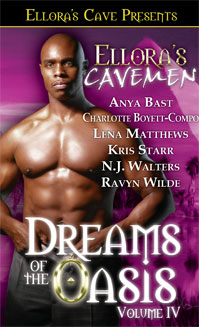
For today’s Smart Bitches Day, I bring you:
Ellora’s CAVEMEN
Dreams of the Oasis, Vol. IV
A few of my beta readers know that my romance-in-progress began its days as an Ellora’s Cave wannabe. I launched into it as ignorant as could be, my erotica knowledge limited to Pauline Reage’s Story of O, Anais Nin’s Delta of Venus, and Anonymous’s Deva-Dasi (hot writer, that Anonymous). But after I was two, three, four chapters into it — and no flesh — my betas informed me I was writing romance, not erotica. Oh, well.
So I was delighted when Kris Starr asked me to read “Virtuosity,” her story in Dreams of the Oasis, Volume IV. Maybe now I would have a clearer idea of what goes into modern erotica.
Here’s the setup. You’re in the faaaar future. Three years after her husband was killed in a surprise Korgon attack, Commander Dillon Walker needs to get her groove on – and her friends know just the thing. Whackin’ off in the HoloSuite! Because, face it, HoloSuites were invented for meaningless, no-strings-attached, no-risk-of-STDs, non-stop, HOT SEX. (You just know that between episodes, Jean Luc Picard was getting a computer-simulated Counselor Troi to give him some o’ dat “around the alpha quadrant” action. And Worf? That Klingon was such a sub. You don’t want to know.)
Enter Aidan. Or perhaps the appropriate syntax is, “Aidan, enter. Several times, please.” Aidan is Dillon’s dream squeeze. He may be a hologram but he’s solid man-flesh, and you know those holocreations can’t be bargained with. They can’t be reasoned with. They don’t whine, fart in bed, or come in your mouth (unless you ask them to), and they absolutely will not stop, ever, until you are satisfied.
It occurs to me that if George W. Bush had taken the money wasted on the Iraq War and used it for basic research, not only would we have true energy independence, but each and every family would have its own HoloSuite. Damn him, damn him to hell!
Rest assured, Dillon is well and truly satisfied by the story’s end; she’s moved beyond the death of Dear Hubs, and a surprisingly human (i.e., not computer generated) prospect looms hornily on her horizon.
How’s the sex? Chick friendly, but what do you expect — this is Dillon’s fantasy, after all. I had hopes for something a tad S&M when Aidan, in 21st Century police officer’s garb, told Dillon she needed to be punished, and followed that with a surly, “Spread your legs, ma’am,” but no tasers, no cuffs, no hot baton action (unless you count what Dillon does to Aidan’s baton in the next scene . . .) Thorough rogering is the name of the game.
It occurs to me that I’m not writing my sex scenes with women in mind. I’m spare on the foreplay, heavy on the genital action, and probably too clinical in my descriptions. If Kris’s story is representative, I need more kissing, breast-groping, and nipple-strumming. My counter-argument is that my protagonists are horny 25-year-olds. Do they have time for foreplay? No! They don’t even have enough time to sleep!
By the way, you know those back-cover author photos? I have just the one for Kris. Here she is with her friend Rella downing shots of Krugy. Note third Krugy comfortably lodged in the author’s cleavage.
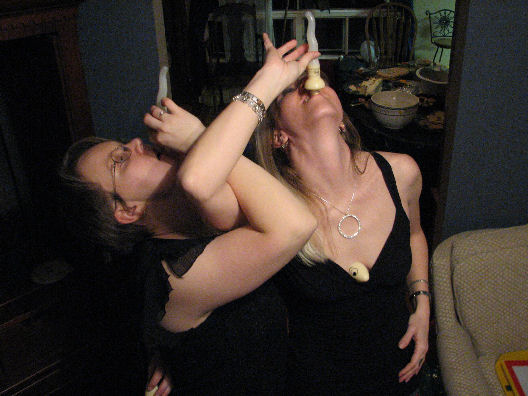
I gotta love two gals who swallow my Krugys.
D.
Why I gave up on Crichton
In the Jan 7 New York Times Book Review, Dave Itzkoff has a hilarious, ripping review of Michael Crichton’s new novel, Next. Here’s the opening paragraph:
Though the moment may lack the inherent gravitas of Harriet Beecher Stowe’s encounter with Lincoln, or even Elvis Presley’s private audience with Richard Nixon, surely history should reserve a special place for the day in 2005 when Michael Crichton was invited to the White House to meet with George W. Bush. Imagine: the modern era’s leading purveyor of alarmist fiction, seated side by side with Michael Crichton. Oh, to be a concealed recording system in that Oval Office! Did Crichton confess to his host that he’d been inspired to write “Rising Sun” by a certain Poppy in chief with a propensity for puking on Japanese dignitaries? Did our president tell Crichton he found the dinosaurs of “Jurassic Park” every bit as frightening as our ancestors did at the dawn of time, 6,000 years ago?
The rest of the review is every bit as good.
Now, you might think I gave up on Crichton because of that fateful meeting in 2005 when he entered the echo chamber of Bush’s brain to confirm the president’s doubts about global warming, but I dismissed Crichton more than twenty years ago. Here’s the story, for what it’s worth.
Capturing the dream
You may not realize it from reading this blog, but I’ve been blocked for well over a month now. To psych myself up for what I hope will be a more productive writing weekend, I thought I’d post a few quotes on fiction-as-consensual-dream, an idea I first encountered in John Gardner’s The Art of Fiction (a book I dearly love and recommend to all writers).
I’ve quoted Gardner before, but it’s been well over a year, and some of you are relatively new to Balls and Walnuts. Here’s the money shot:
If we carefully inspect our experience as we read, we discover that the importance of physical detail is that it creates for us a kind of dream, a rich and vivid play in the mind. We read a few words at the beginning of the book or the particular story, and suddenly we find ourselves seeing not words on a page but a train moving through Russia, an old Italian crying, or a farmhouse battered by rain. We read on — dream on — not passively but actively, worrying about the choices the characters have to make, listening in panic for some sound behind the fictional door, exulting in characters’ successes, bemoaning their failures. In great fiction, the dream engages us heart and soul; we not only respond to imaginary things — sights, sounds, smells — as though they were real, we respond to fictional problems as though they were real: We sympathize, think, and judge. We act out, vicariously, the trials of the characters and learn from the failures and successes of particular modes of action, particular attitudes, opinions, assertions, and beliefs exactly as we learn from life. Thus the value of great fiction, we begin to suspect, is not just that it entertains us or distracts us from our troubles, not just that it broadens our knowledge of people and places, but also that it helps us to know what we believe, reinforces those qualities that are nobles in us, leads us to feel uneasy about our faults and limitations.
This is one of those paragraphs, like Nathanael West’s cannonball quote, which I revisit to fire myself up. If all else fails, I’ll write a bit of short fiction — that will often break a block. I’ve posted a new challenge over at Writer’s BBS, so perhaps I’ll participate in it. Something, anything to get unblocked.
I wish the muse would tell me what’s bugging her.
Back to fiction-as-consensual-dream. I’ve been rereading Conrad’s Heart of Darkness (I read it for the jokes), and came across this today:
It seems to me I am trying to tell you a dream — making a vain attempt, because no relation of a dream can convey the dream-sensation, that commingling of absurdity, surprise, and bewilderment in a tremor of struggling revolt, that notion of being captured by the incredible which is the very essence of dreams . . .
And I wonder if he wasn’t thinking about writing — or perhaps editing — as he wrote these words:
No, I don’t like work. I had rather laze about and think of all the fine things that can be done. I don’t like work — no man does — but I like what is in the work — the chance to find yourself. Your own reality — for yourself — not for others — what no other man can ever know.
I would argue that Conrad’s Marlow is wrong on both counts. He does capture the dream-sensation; that’s the beauty of Heart of Darkness. And I also think he conveys to the reader his perception of reality.
That’s the goal, then; that’s the prize. When you can immerse your readers in the dream, even to the point of sharing those inexplicable dream sensations, you’ve succeeded in your task. Entertainment is important too, of course, but the two goals go hand in hand. I think the reading experience is so much more satisfying when the author falls away, is forgotten, disappears from view. We aren’t writers so much as we are conjurers. What better magic than when the magician himself vanishes?
D.
SBD: Sex, Gatsby, and overreaching
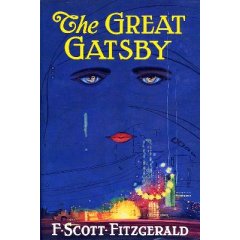 You might not think Candace Bushnell’s Sex and the City and F. Scott Fitzgerald’s The Great Gatsby have much in common, other than the fact both focus on the lives of the shallow, nouveau riche, but for Beth’s Smart Bitches Day (which I have ignored these last several weeks for lack of anything to say), I can do better than that.
But first, you’re probably wondering what happened to me yesterday. Or not. Maybe I shouldn’t assume your lives depend on me posting at least once a day, hmm? Anyway, let me quickly say WE’RE BOTH FINE. It’s good for hospital morale if the employees see their physicians (and soon to be chief-of-staff, I might add haughtily) use the emergency facilities. It fills them with confidence. And besides, the nearest larger hospital is another seventy miles south, not that that had anything to do with our choice of hospitals. Nope, nothing at all. In any case, I don’t have pneumonia and Karen didn’t have a heart attack so I guess we’re both a couple of hypochondriacs.
Am I boring you yet? Here. Check out Renee’s Christmas card to me. One question, Renee: is that mistletoe hanging over your girlfriends, and if so, may I please have a raincheck?
Onward to more serious Smart Bitchery . . .
Logophilia
I’m reading The Shadow of the Torturer by Gene Wolfe, recommended to me by M E-L of Ishbadiddle, and I love it. It’s part SF, part fantasy, all bildungsroman. Click that link if you gagged on bildungsroman . . . cuz guess what, kids, this post is about words.
Provided the rest of the book is good stuff, I don’t mind an onslaught of obscure words. Reginald Hill’s Dialogues of the Dead comes to mind — a book I loved right up until the resolution of the mystery, then hated. But Hill’s book was all about a love of words, and I learned many cool ones by reading it. Words like bheesty (a water-carrier) and dogsbody (a drudge). Yeah, I knew ‘dogsbody’ from watching Black Adder, but Hill’s book forced me to look it up for a change.
With The Shadow of the Torturer, I’m not sure how many of these are real words and how many are neologisms. I haven’t had a chance yet to look up every last one, but I intend to. Meanwhile, I’m scribbling strange words on my bookmark.
Here they are. Recognize any of ’em?
thurible
paphian
anacreontic
epopt
matross
peltast
cataphract
anagnost
psychopomp
uhlan
caique
paterissa
baldric
sabretache
bartizan
flageolet
lansquenet
. . . and several more. Some of these I think I should know (baldric, psychopomp, thurible, cataphract) but many of them are as familiar as the surface of Neptune.
I know obscure words bother some readers, and they bother me, too, when they’re out of place. In this book, they all seem strangely appropriate. (Yes, I’m still tweaked over the opening of Stephen King’s Gunslinger. Apotheosis of deserts, really.)
Here’s one I thought Gene Wolfe had made up: sardonyx. But I was wrong.
How about you guys? Have any favorite obscure words?
D.
SBD 2: Bushnelled
Whenever Jake has Taekwondo, I have an hour of down time. Today, I went to our local megalomart in search of a good book. God forbid I should try to sit alone with my own thoughts for an hour. Anyway, here’s what I found:
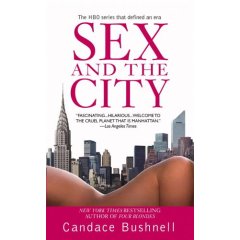
I loved the TV show well enough to write a horror spoof of it (“Sex and the Single Wendigo”, waaaay up in the upper lefthand corner). So I should love the book, too — right? Well. I’m only 2.5 chapters into the book, so it would be unfair to judge it so soon, but so far: Meh.
The book and the show seem so fundamentally different. The women in the show approached relationships and sex with inexhaustible hope and gusto, while the men and women of Sex and the City le book have in place of hearts, lumps of coal. The show was a romance, the book, anti-romance.
But it was the Introduction to this edition (pictured above) which really grabbed my attention. The author herself wrote the intro, dated 2001, and oh boy is it an eye-opener. See, I always thought it worked this way:
- You write a book.
- If it gets published, and if it assumes some degree of social or literary significance, brainy types will pen brilliant criticism discussing your book.
It had never occurred to me that the author could pen her own brilliant criticism, but that’s what Candace Bushnell has done. From her Intro:
I suppose that’s why Sex and the City is such an unsentimental examination of relationships and mating habits. Although some people find its lack of sentiment and cruel humor disturbing, it’s probably only because the book contains some kind of universal truth.
What possessed Bushnell to write a new ending for SatC? No insight there, but she does reveal the ending. That’s right — she gives a spoiler for her own book. And then she analyzes the new ending and tells us what it means!
And so, at last, the book has a real ending, in which Carrie and Mr. Big break up. [WTF? That’s not how the series ended!] It’s a bittersweet ending [Really? You thought so? How good of you to tell us how to feel] — not just the end of Carrie’s relationship with Mr. Big, but the end of her dream of finding the proverbial Mr. Big — a man who doesn’t really exist [While you’re at it, please provide a list of all symbols used in the book and tell us what each symbol represents.] If you read closely [Are you listening, all you barely literate readers who fail to understand my all new ending?], you’ll discover that even Mr. Big himself points out that he is a fantasy in Carrie’s imagination, and that you can’t love a fantasy. And so we leave Carrie to enter a new phase of her life when she understands that she will have to find herself (without a man), and in doing so will hopefully be able to find a relationship.
Maybe I’m not as unsentimental as I thought. [But are you as arrogant as you thought?]
This is breathtaking, really breathtaking. I’m all snarked out.
D.
Frog Talk Responsa
Q: What’s your favorite thing about writing a blog?
One favorite thing? The audience. I love having an audience.
Q: If you had a choice between making your living as a writer or as a chef, which would you take?
Writer. Cooking is fun, but the mental challenge of writing is much deeper, and more varied. I suspect being a chef would get dull after a while.
Q: If you could spend one day learning from any chef in the world, who would you choose and why?
Julia Child. We would have to resurrect her, of course, and hopefully she wouldn’t have that zombie problem. (If all she ever says is, “MORE BRAINS,” then I’ll know I wasted my opportunity.) What would I learn from her? I’d love it if she would teach me to be a better baker.
Q: If you could step back in time and right a wrong, which one would it be?
Easy. The theft of the 2000 election by George Bush. I can think of other historical wrongs of greater magnitude, but the farther back you go, the harder it is to predict unintended consequences. A Gore presidency? I can’t see any downside.
Q: If you could talk to only one famous writer for two hours, who would it be?
Probably Vonnegut. He’s a hoot. Fitzgerald or Faulkner would be too drunk, Conrad or Dostoevsky too depressing, P. K. Dick too crazy.
Q: If you could collaborate on a novel with any writer, past or present, who would it be?
Toughie. My one attempt at a collaboration (on a screenplay) ended in disaster, thanks to the other guy being . . . ah . . . what’s the polite term for nuts?
This is like my sister’s chef question. Whom would I most like to learn from? When I look at it like that, I think of the contemporary writers whom I admire the most: John LeCarre and Martin Cruz Smith. Of the two, I think I like Smith the most.
As for dead authors . . . Raymond Chandler.
By the way, did anyone notice the remarkable similarity of the recent polonium poisoning of the Russian ex-spy with the plot of Smith’s Wolves Eat Dogs? Uncanny!
Q: What is your favorite post from your blog?
I’m afraid this changes with my mood. Today, I’m feeling glum and pensive (you know why, CD), so I would have to go with either Thirteen Patients or Healer. Ask me on another day and you’re likely to get another answer.
Q: What is your all time favorite recipe?
You think I would hold back on something like that? Although my family is sick of it (at one time, I made it once a week), tagine still ranks as one of my personal favorites. That tagine recipe has it all: depth of flavor, complexity of texture, variety of color. It’s the perfect main course. Close runner up: velvet butter chicken for its richness and flexibility — you can use that same basic recipe for any meat, fish, or shellfish, and it would probably work for tofu as well.
Q: If you could visit any country, that you have not been to, which one would it be and why??
Another toughie . . . but if I’m travelling solo, I would pick Antarctica, because there’s nothing like it anywhere else on Earth. Does anyone remember the blog 75 Degrees South? Simon posts some spectacular photographs of Antarctica (click on “Gallery” in his menu). I figure, if it’s breathtaking to look at a small, two-dimensional photo, how much more spectacular would it be to see it in person? Memories to last a lifetime.
That’s it for now. We’ll do another Frog Talk some time soon, so save up your questions!
D.